
Scholarship essays can feel high-stakes for a simple reason: you are not just trying to get admitted, you are asking someone to invest in you. The good news is that a standout scholarship essay is not about sounding impressive or having a dramatic life story. It is about helping the reader believe you will use this opportunity well, and supporting that belief with clear, grounded evidence.
Below, you will get a step-by-step process for choosing the right angle, brainstorming the right story, drafting an opening that earns attention, and revising until your message is crisp and memorable. You will also find a copy-ready structure template, a mini sample, and a few submission tips that can save you from avoidable mistakes.

What makes a scholarship essay different
A college application personal statement usually answers, “Who are you?” A scholarship essay often answers, “Why you, for this money, and why now?” That shifts what matters most.
- Mission match: Scholarship committees often have a purpose (first-generation support, leadership, service, STEM, arts, community impact). Your essay should connect directly to that purpose.
- Proof over personality: Warmth helps, but concrete proof usually carries more weight. Show you follow through, solve problems, or lead with consistency.
- Clarity and efficiency: Readers may review dozens or even hundreds of essays. Clean structure and tangible details build trust and make your essay easy to score.
Step 1: Choose the prompt you can answer with proof
If you get to pick from multiple prompts, choose the one where you can provide the most verifiable evidence. “Verifiable” means names of roles, numbers, time frames, actions, and outcomes.
Use this quick prompt test
- Story test: Can you tell a 1 to 2 minute story out loud that answers the prompt?
- Evidence test: Can you include at least two measurable details (hours, funds raised, GPA change, students tutored, games played, projects shipped, certifications earned)?
- Uniqueness test: Could someone else at your school copy-paste your essay and it still fit? If yes, it is too generic.
- Mission test: Can you clearly name how your values align with the scholarship’s purpose without forcing it?
If you only have one prompt, do the same test to choose the best angle. Most prompts are broad on purpose. Your job is to narrow.
Also: If the scholarship provides selection criteria or a scoring rubric, treat it like a checklist. Pull out the keywords (leadership, service, perseverance, academic focus) and make sure your essay clearly demonstrates them without copying the rubric language.
Step 2: Brainstorm a specific story (not a résumé)
The fastest way to blend in is to summarize your achievements. The fastest way to stand out is to zoom in on one moment and show your thinking.
Try the “moment, meaning, move” brainstorm
- Moment: A snapshot scene. Where were you? What was happening? What problem did you face?
- Meaning: What did you learn about yourself, your community, or your goals?
- Move: What did you do next because of that lesson? (This is where scholarship committees see momentum.)
5 story starters that often work well
- A turning point in your learning: The class, teacher, project, or failure that changed how you study or what you want to pursue.
- A responsibility you carry: Work, caregiving, translation for family, community commitments, or navigating systems on your own.
- A service experience with results: Not “I volunteered,” but “I noticed a gap, tried something, adjusted, and improved it.”
- A leadership moment: When you influenced a group or solved a problem, especially behind the scenes.
- An obstacle and the strategy you used: Focus on the tools you built, not just the hardship.
Step 3: Map your answer before you draft
Before you write full paragraphs, create a one-sentence plan for each piece of your essay. This keeps your draft focused and prevents rambling.
- Thesis in plain language: “I should receive this scholarship because I have demonstrated X, I am pursuing Y, and I will use this opportunity to do Z.”
- Story point: The one scene that proves X.
- Bridge: How the story connects to your goals and the scholarship’s mission.
- Future: A specific plan for how funding helps you move forward.
Step 4: Write an opening that earns attention
Your first three to five sentences matter because they set the tone and signal whether your essay will be easy to read. You do not need a shocking hook. You need a specific one.
Openings that tend to work
- Start in the scene: “At 5:30 a.m., I unlocked the gym because our robotics team needed quiet space to test.”
- Start with a problem you took ownership of: “Our English learners were missing key announcements, so I built a bilingual weekly update.”
- Start with a value, then prove it quickly: “Consistency is my strength, and it is why I kept showing up for my siblings’ homework even after my shift ended.”
A simple hook formula
Specific moment + what it revealed about you
Example: “When our community pantry ran out of fresh produce, I realized good intentions were not enough. I needed a system, not a one-time drive.”
Step 5: Use a structure template (copy this)
Adapt the length to your word limit, but keep the order. This structure is readable, persuasive, and easy for busy reviewers to follow.
Scholarship essay structure template
- Paragraph 1 (Hook + direction): Begin with a specific moment. End the paragraph with a clear statement of what you value and what you are working toward.
- Paragraph 2 (Story + actions): Describe what you did. Include 2 to 3 tangible details: time, responsibility, results, or obstacles you navigated.
- Paragraph 3 (Reflection + skills): Explain what you learned and what skills you built (resilience, leadership, communication, problem-solving, discipline). Keep it grounded in the story.
- Paragraph 4 (Mission match): Connect your values and goals to the scholarship’s purpose. Name the match directly and sincerely.
- Paragraph 5 (Future plan + close): State exactly how the scholarship will help (tuition gap, books, transportation, certification fees, reduced work hours). End with a forward-looking line that shows momentum.
Tip: If the prompt is “Why do you deserve this scholarship?” your answer should include both earned trust (what you have already done) and smart use (what you will do next with support).
Mini sample
Sample scholarship essay (about 190 words)
At 6:45 a.m., I stood in the school office translating a voicemail about schedule changes for a parent who works nights. It was not the first message I had translated, but it was the first time I realized how easily important information disappears when it is not in your language.
That week, I asked our counselor for the most common announcements families missed, then created a one-page bilingual update in Spanish and English. I sent it every Friday for nine weeks and tracked questions that came back. By the end of the quarter, our front office told me they were receiving fewer last-minute calls about deadlines, and two parents asked to volunteer for the first time because they finally knew when meetings happened.
I learned that service is not just showing up. It is noticing a pattern, building a system, and improving it. That mindset is why I am pursuing a degree in public health, where clear communication can be the difference between access and missed care.
This scholarship would let me reduce my work hours and pay for required lab fees so I can stay on track to serve bilingual communities with the same reliability I practiced at my school.
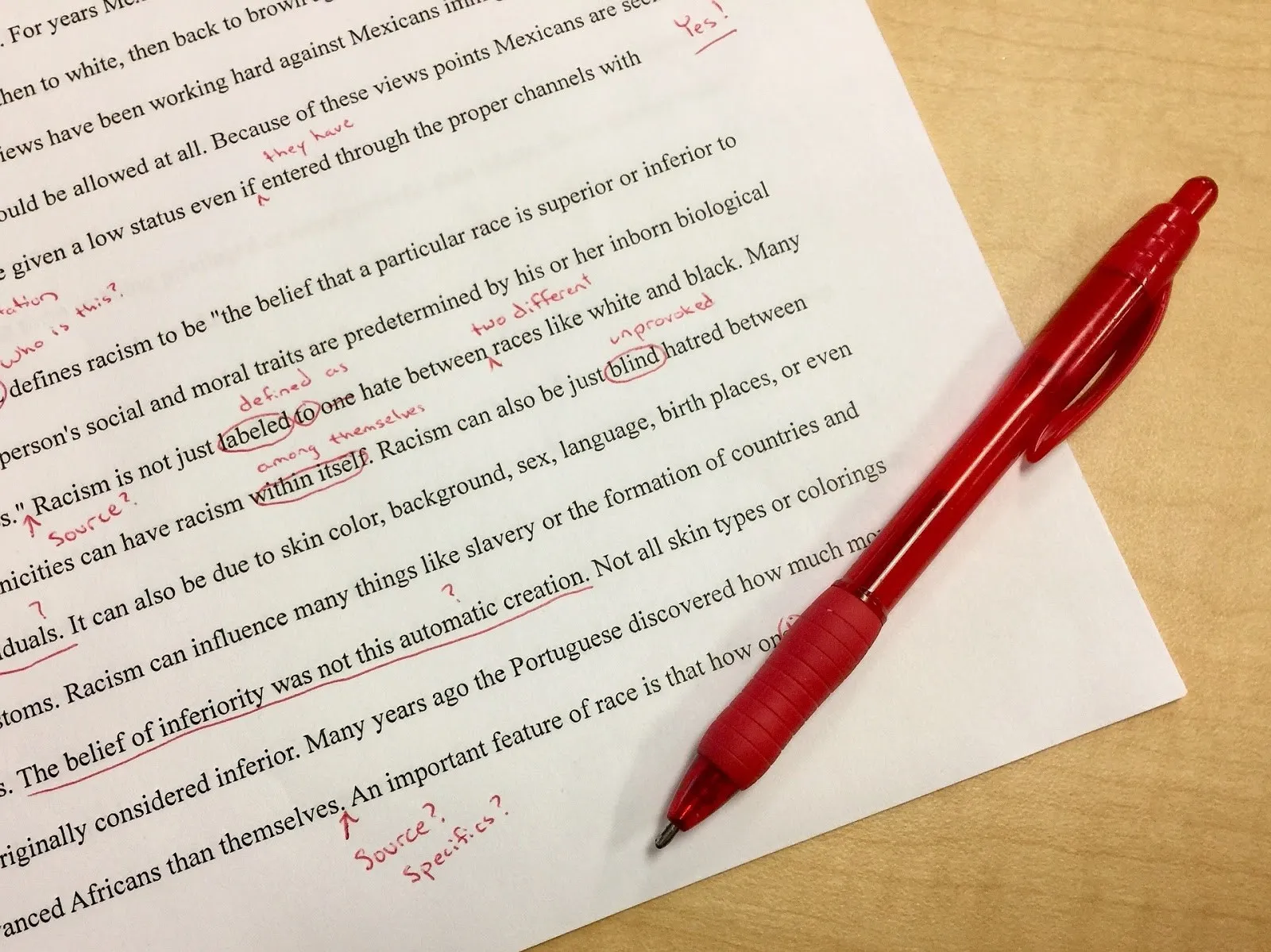
Step 6: Revise for clarity and impact
Strong scholarship essays are rarely written in one sitting. They are built in revisions. Here is a revision routine that works even when you are busy.
Revision pass 1: Make it easy to understand
- Underline your main point in each paragraph. If you cannot, the paragraph is doing too much.
- Cut or rewrite any sentence that makes the reader pause to decode meaning.
- Replace vague phrases with specifics: “helped” becomes “tutored twice a week for 10 weeks.”
Revision pass 2: Make it impossible to mistake for someone else’s
- Add one detail only you would include: a responsibility, a context, a family dynamic, a local need, a cultural insight, a work schedule.
- Swap generic traits for proof: instead of “I am hardworking,” show the choice you made when something got difficult.
Revision pass 3: Tighten the language
- If the first sentence of a paragraph repeats what you already said, consider cutting it or combining it with the next sentence.
- Remove filler: “in order to,” “really,” “very,” “I believe,” “I feel.”
- Check verbs. “Was” and “had” can often become stronger actions: “organized,” “built,” “advocated,” “tracked,” “improved.”
Revision pass 4: Confirm you answered the prompt
Print the prompt or paste it at the top of your draft. Next to each paragraph, write which part of the prompt it answers. If you cannot label it, revise or cut.
Common mistakes (and what to do instead)
- Mistake: Writing a life story with no focus.
Do instead: Pick one story that proves your values and direction. - Mistake: Repeating your résumé.
Do instead: Use the essay to show decision-making, growth, and character behind the activities list. - Mistake: Sounding generic: “I want to help people.”
Do instead: Name who, how, and why: “I want to become a speech-language pathologist to support bilingual students who are misidentified in early reading interventions.” - Mistake: Overusing big words to sound academic.
Do instead: Write clearly. Many programs reward clarity more than thesaurus vocabulary. - Mistake: Centering hardship without showing agency.
Do instead: You can absolutely mention challenges, but spend more space on the strategy you used and what you built from it. - Mistake: Missing the “so what.”
Do instead: After your story, explicitly connect it to your goals and the scholarship’s purpose. - Mistake: Not proofreading basics.
Do instead: Read aloud, run a spellcheck, and ask one trusted person to look for confusing sentences.
Credibility details that help
When reviewers trust you, they relax into your essay. Trust comes from grounded details and a calm, honest tone.
Credibility builders you can add naturally
- Time frame: “Over the past two years…”
- Scope: “I supported 12 students…”
- Constraints: “While working 20 hours a week…”
- Outcome: “Attendance improved from…” or “We delivered…”
- Reflection: “I realized my first plan did not work because…”
You do not need to sound perfect. You need to sound real, thoughtful, and prepared.
Honesty and privacy
The fastest way to weaken an essay is to stretch the truth. Do not inflate hours, leadership titles, impact numbers, or hardship. If you mention a metric, make sure it is accurate and you can explain it if asked.
Be thoughtful with sensitive topics. You can write about family, health, or finances, but protect privacy. Use general terms for other people (for example, “a student I tutored” instead of a name) and share only what you would feel comfortable discussing in an interview.
Submission tips
- Character counts are different from word counts: If a portal gives a character limit, draft inside that limit. Some systems count spaces.
- Keep formatting simple: When pasting into an application box, italics, bullet points, and paragraph spacing can break. Paste into a plain text editor first, then paste into the portal and review.
- File names matter: If you upload a document, use a clear name like “FirstLast_ScholarshipName_Essay” so your file is easy to track.
- Follow instructions exactly: If they request PDF, upload PDF. If they request a specific font or header, match it.
Quick checklist before you submit
- My opening is specific, not generic.
- I answered the prompt directly, not sideways.
- I included at least two concrete details (numbers, time, outcomes).
- I explained how I will use the scholarship funds.
- I connected my story to the scholarship’s mission.
- I removed clichés and vague claims.
- I proofread and formatted exactly as instructed (word count or character count, file type, font if required).
FAQ
How long should a scholarship essay be?
Follow the instructions exactly. If there is a word limit, treat it as a maximum, not a goal. If there is a range, aim for the middle to upper part of the range so you have room for a story and reflection without rambling.
Can I reuse the same scholarship essay for multiple applications?
Yes, as a starting point. Keep one “core” essay, then customize the mission match paragraph and the final paragraph to reflect each scholarship’s purpose and any unique requirements.
Is it okay to write about financial need?
If the prompt asks about need, address it clearly and respectfully. Pair need with a plan: how the scholarship changes your ability to study, reduce work hours, cover transportation, or stay enrolled. Even in need-based essays, committees still look for follow-through and goals.
Should I mention grades or test scores?
Only if it strengthens the story or the prompt calls for it. Many committees already have your transcript. Use the essay to add context, growth, and direction, especially if a number does not tell the full story.
Final encouragement
If you are staring at a blank page, start smaller: write the moment first. Not your background, not your résumé, just the scene. Once you have one real moment on paper, the rest of the essay becomes a matter of connecting the dots, and that is a skill you can learn.