
Credit by exam is one of those options that can feel almost too good to be true: you demonstrate what you already know by passing a test, and your school may award you college credit without you taking the full course. For the right student, it can shave time off a degree plan or help you skip an entry-level requirement. For others, it is a detour that does not actually move graduation any closer, like earning elective credit when what you really need is a specific general education or major course.
Below, I will break down how credit by exam works in plain language, who it tends to help most, how tests like CLEP fit in, and the exact questions to ask your college before you spend time studying or money on exam fees.

What is credit by exam?
Credit by exam is a way to earn academic credit by passing an approved exam instead of taking the course. Schools use it to recognize prior learning, meaning knowledge you gained outside that particular class.
Credit-by-exam exams most often map cleanly to survey or introductory academic subjects (for example, composition, algebra, U.S. history, or introductory psychology). That said, students come in with prior learning from many places, such as:
- Independent study or reading
- Homeschooling or self-paced learning
- Military training
- Time in another program where you did not earn transferable credit
- Learning from tutoring, bootcamps, or online courses
- Work experience and on-the-job training (more commonly evaluated through other prior learning assessment methods, but occasionally aligned with an exam depending on the school)
Think of it like this: if a course is essentially proof that you mastered certain outcomes, an exam can sometimes serve as that proof.
How schools award credit by exam
Every institution sets its own rules, but the process usually looks like this:
1) The school chooses which exams it accepts
Some colleges accept widely used standardized exams (like CLEP). Others also offer departmental challenge exams, which are tests written and administered by the college itself to cover a specific course.
2) The school sets the required score
There is almost always a minimum score required to earn credit, and it can vary by campus, by department, and sometimes even by major.
3) Credit is posted in a specific way
Credit by exam typically appears on your transcript as:
- Pass/credit (no letter grade)
- Credit hours attached to a course number (for example, “HIST 101 credit”)
- No effect on GPA in many cases (confirm how your school records it)
That last point can be a perk if you are protecting your GPA, but it can also be a limitation if you need a grade for a program requirement. Some majors and graduate programs care about graded coursework in key prerequisites.
4) The credit must fit your degree plan
This is the step families miss most often. Earning credit is not the same as satisfying your specific requirement. The same 3 credits might count as:
- a general education requirement at one school
- a free elective at another
- not usable at all for a tightly structured major
Where CLEP fits in
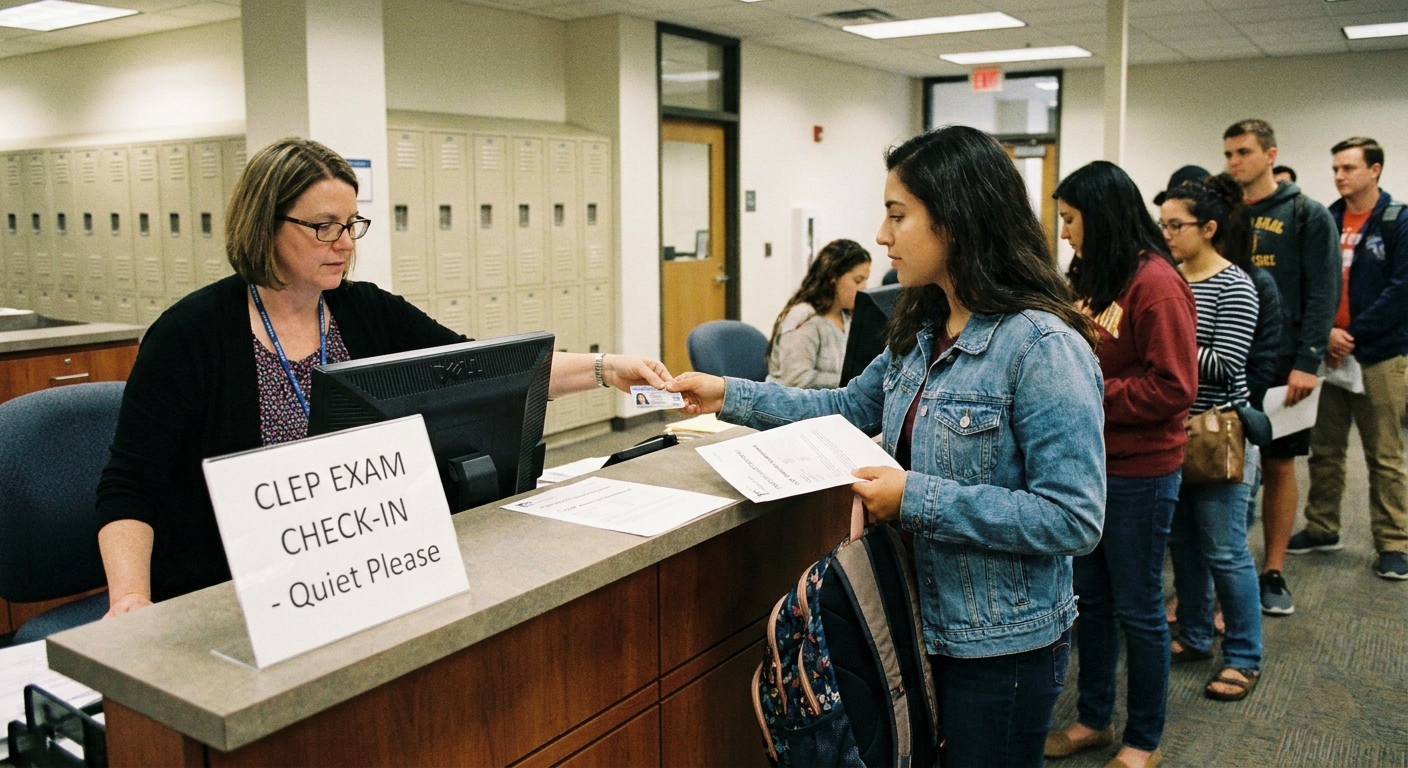
CLEP (College-Level Examination Program) is one of the best-known credit-by-exam options in the United States. CLEP exams are standardized tests offered in subjects like composition, math, history, psychology, and foreign languages.
Here is the key: your college awards the credit, not the exam program itself. CLEP provides the exam and score report, and your college decides whether to accept CLEP, which CLEP exams count, and what score you need.
Other common exam programs
Depending on the school, you may also see options such as DSST exams or institution-specific exams. Availability and policies can change over time, so always check the current catalog or registrar guidance for your campus.
Common ways colleges apply CLEP credit
- General education: College Algebra, Intro Psychology, U.S. History
- Placement plus credit: Some schools use a language exam to place you into a higher course and award credit for lower levels
- Elective credit: Credit counts toward total hours but not a specific requirement
Who credit by exam helps most
In my advising work, credit by exam tends to be most helpful for students in a few situations:
Students returning to school
Adult learners often bring real knowledge from work, certifications, or years of life experience. Testing out of an entry-level course can speed up the path to a credential.
Students who are strong test takers
If you can learn content efficiently and perform under timed conditions, this pathway may feel straightforward.
Students with uneven transcripts but strong mastery
Sometimes a student did not have access to AP courses, dual enrollment, or advanced electives, but they did learn the content. Credit by exam can be a second chance to have that learning recognized.
Military-connected students
Many institutions are familiar with credit recognition systems for service members, and credit by exam can complement other evaluations of prior learning.
When credit by exam saves money
Credit by exam is most likely to save you money and time when it helps you do at least one of the following:
- Skip a required course you would otherwise have to pay for
- Meet a prerequisite so you can take upper-level classes sooner
- Reduce total credits needed for graduation (some programs allow this, others require a minimum number of credits taken in residence)
- Avoid repeating content you truly already know
It is also useful if you are trying to lighten a semester course load while still progressing toward graduation. For example, earning 3 credits by exam may allow you to take 12 credits instead of 15 while staying on pace.
If the credit only counts as a free elective you do not need, you may earn credit without earning progress. Always check how the credit applies to your specific degree audit.
When credit by exam is less useful
Credit by exam is not a magic shortcut for every student or every degree. It can be less helpful when:
Your program has strict sequencing
Nursing, engineering, architecture, and many health science tracks often require a specific set of in-residence courses with labs and cohort progression. Even when exams are accepted, they may not replace the classes that control progression.
You need a letter grade
Some majors require a minimum grade in prerequisites, and some graduate or professional programs want graded coursework in foundational subjects (for example, statistics, lab sciences, or writing-intensive courses). Pass credit may not satisfy that expectation.
Your school caps exam credit
Colleges often set limits on how many credits you can earn via exam. The cap varies widely by institution and program, and sometimes the practical limit is created by residency rules rather than a single published number.
You are early in college and still building academic skills
There is value in taking a class, especially for first-year students learning college expectations, writing standards, and study habits. Testing out can be smart, but you do not want to skip the very supports that help you succeed later.
Costs and logistics
Typical costs
Fees vary by exam type and testing site, but you can usually expect:
- An exam fee (set by the testing program)
- A separate testing center or proctoring fee at some locations
- Optional study materials or practice tests
Even with fees, credit by exam can still be far cheaper than tuition for a 3-credit course, especially at four-year institutions. But the math only works if the credit applies to a requirement you truly need.
How long it takes
Timeline depends on how quickly you can prepare and how soon your school posts the credit. Some students study for a few weeks and test. Others take longer, especially for subjects that require practice (like math or a foreign language).
Where you take the exam
Many exams are administered through approved test centers, often on college campuses or at dedicated testing facilities. Some exams also offer remote proctoring in certain cases, but availability depends on the exam program, the location, and current policies, and it can change.

How to check your school policy
Before you register for any exam, get clear answers to these questions. You can usually find them on your registrar site, academic catalog, or testing and credit page, and you can confirm with an advisor.
Questions to ask
- Which exams do you accept? (CLEP, DSST, departmental challenge exams, others)
- What minimum score is required? (and does it vary by major)
- What course equivalencies do you grant? (for example, which exact class number)
- Does the credit meet general education, major requirements, or only electives?
- Will it satisfy prerequisites?
- How many credits by exam can I apply toward my degree?
- Does the credit count toward residency requirements? (the number of credits you must earn through that institution, sometimes including upper-level in-residence requirements)
- Will it affect my GPA? (and how will it appear on the transcript)
- Are there limits on when I can take it? (before enrollment, after enrollment, within the first term, etc.)
- If I do not earn the score I need, can I retake it? (and after how long)
One more practical “gotcha” to ask about: Will this affect my financial aid or scholarship status? Some aid programs depend on enrolled credit load each term, and exam credit may not count the same way as credits you are currently taking.
If you are choosing between taking the class or testing out, ask one more important question: How will this choice affect my next semester schedule? The best credit decisions support momentum.
Credit by exam vs. other options
Families often mix these up, so here is a quick, plain-language comparison:
- Credit by exam: You pass an approved exam and your college grants credit.
- AP credit: You take an AP course in high school and earn credit based on your AP exam score, if your college accepts it.
- Dual enrollment: You earn college credit by taking an actual college course, often while in high school.
- Transfer credit: You transfer completed coursework from one college to another.
- Prior learning assessment (PLA): Some schools evaluate learning through portfolios, interviews, or documented training and may award credit. Credit by exam is one form of PLA at many institutions.
Decision checklist
If you are unsure whether credit by exam is worth it, use this quick checklist:
- I can explain exactly where the credit will apply in my degree plan.
- I am confident I can hit the required score with reasonable preparation time.
- This credit helps me move forward (prerequisite, gen ed requirement, or needed elective).
- I have confirmed limits on exam credit and residency requirements.
- I do not need a letter grade for this requirement.
If you cannot check at least the first and third boxes, pause and verify details with your advisor or registrar before you register for an exam.
FAQ
Does credit by exam look bad on a transcript?
For most students, no. It typically appears as credit awarded without a letter grade. Many schools treat it like other accepted credits (such as AP). The bigger issue is not how it looks, but whether it satisfies the requirements you need for your major or future plans.
Can credit by exam help me graduate early?
It can, especially if it replaces multiple general education courses or prerequisites and your program has flexibility. Graduation timelines depend on course sequencing, residency rules, and how many credits your degree requires.
Can I use exam credit for major courses?
Sometimes, but it depends heavily on the department. It is more common for intro-level courses and general education. Upper-level major courses are less likely to be replaced by exam credit.
What if my school accepts CLEP but my department does not?
This happens. The institution may award elective credit, while the department requires the actual course for the major. In that case, the CLEP credit might still help you reach total credit requirements, but it may not help you meet the specific major requirement.
How often can I retake an exam?
Retake rules depend on the exam program and can change. Many exam programs impose waiting periods between attempts, so confirm the current retake policy before you test, especially if you are working against a registration or graduation deadline.
Is it better to take the class instead?
If you need structured support, want deeper practice, need a letter grade, or the class is foundational for later success, taking the course can be the wiser choice. Credit by exam is best when you already have strong mastery and the credit cleanly fits your plan.