
If your child is struggling in school, you may hear the phrase “IEP” for the first time and feel like everyone else understands a system you missed. You are not alone. An Individualized Education Program (IEP) is a written plan that explains how a public school will provide special education services to meet a student’s unique learning needs.
In plain language: an IEP is the school’s promise, in writing, of the supports, goals, and services a student will receive and how the team will measure progress.

What an IEP is (and what it is not)
IEP definition
An IEP is a legal document created for a student who qualifies for special education under the Individuals with Disabilities Education Act (IDEA), a federal law in the United States. The plan outlines:
- Present levels of academic and functional performance (how the student is doing right now)
- Annual goals (what the student should achieve in about a year)
- Services and supports (specialized instruction, therapies, and accommodations as needed)
- Placement (where services are provided and how much time the student spends in general education)
- How progress will be measured and shared with families
IEP vs. 504 Plan
These two plans are often confused because both can provide school supports.
- IEP: for students who qualify for special education under IDEA and need specialized instruction and related services.
- 504 Plan: for students with a disability who need accommodations and supports to access learning (for example, extended time, preferential seating). A 504 plan falls under Section 504 of the Rehabilitation Act and does not provide IDEA special education.
IEP vs. intervention supports (RTI/MTSS)
Before special education evaluation, many students receive extra help through school-wide systems like RTI (Response to Intervention) or MTSS (Multi-Tiered System of Supports). These supports can be helpful, but they are not the same as an IEP.
Important note: Schools should not use RTI/MTSS to postpone or deny a timely special education evaluation when a disability is suspected or when a parent requests an evaluation.
Who qualifies for an IEP?
To qualify, a student must meet two requirements:
- The student has a disability that fits one of IDEA’s eligibility categories (your school may use slightly different wording, but the categories are set by law).
- Because of that disability, the student needs special education, meaning specialized instruction, not only accommodations.
IDEA eligibility categories (plain language)
- Specific Learning Disability (SLD): persistent difficulty in areas like reading, writing, or math, not explained by lack of instruction.
- Speech or Language Impairment: challenges with speech sounds, fluency (stuttering), voice, or language skills that affect school performance.
- Autism: differences in communication and social interaction, often with sensory or repetitive behavior needs that impact learning.
- Other Health Impairment (OHI): health-related conditions that affect alertness or stamina, often including ADHD when it impacts school functioning.
- Emotional Disturbance: significant emotional or behavioral needs over time that affect learning.
- Intellectual Disability: limitations in intellectual functioning and adaptive skills that impact learning.
- Deafness: hearing loss that significantly impacts communication and learning and often requires specialized instruction and supports.
- Hearing Impairment: hearing loss (not meeting the definition of deafness) that still affects educational performance.
- Visual Impairment (including blindness): vision loss that affects access to learning and may require specialized supports.
- Deaf-Blindness: combined hearing and vision needs requiring specialized services.
- Orthopedic Impairment: physical challenges affecting access and participation.
- Traumatic Brain Injury (TBI): learning or behavior changes after an injury.
- Multiple Disabilities: more than one disability requiring combined support.
- Developmental Delay: used in some states for younger children (often ages 3 to 9), depending on state rules.
Eligibility is not based on a single test score or a single tough semester. The team looks at multiple data points, and most importantly, whether the disability is affecting access to education in a way that requires specialized instruction.

The IEP process, step by step
Schools may use slightly different paperwork, but the overall process tends to follow the same path. Here is a parent-friendly roadmap.
Step 1: A concern is raised (referral)
A referral happens when someone says, “We think this student may need special education support.” A referral can come from:
- A parent or guardian
- A teacher
- A school counselor, admin, or support team
- Sometimes a doctor or outside specialist (shared with the school)
If you are a parent, you can put your request in writing and keep a copy for your records. A simple email is fine.
Step 2: The school asks for consent to evaluate
Before the school can do a full special education evaluation, they must typically get written parent consent. This is one place families can slow the process without realizing it, so if you agree to testing, return consent forms promptly.
Step 3: Evaluation happens
The evaluation is not just one test. It is a set of assessments and observations that may include:
- Academic testing (reading, writing, math)
- Cognitive or processing measures (as appropriate)
- Speech-language evaluation
- Social-emotional or behavior rating scales
- Classroom observations
- Review of work samples, grades, progress monitoring data, attendance, and teacher input
Families can also share outside evaluations, medical notes, or therapy reports. The school team considers them, even if they still complete school-based testing.
Step 4: Eligibility meeting
After evaluation, the team meets to answer two big questions:
- Does the student meet criteria for a disability category under IDEA?
- Does the student need special education services to make appropriate progress in school?
If the answer is yes, the next step is creating an IEP. If the answer is no, the team may still recommend supports, such as a 504 plan or targeted interventions.
Step 5: IEP meeting and plan development
This is where the written IEP is created. The team reviews strengths, needs, and evaluation results, then writes goals and decides services and supports.
Step 6: Services begin
Once eligibility is determined and the IEP is finalized (and any required consent to start services is signed, where applicable), the school implements the plan. This can include:
- Specialized instruction (in a small group, co-taught class, or other setting)
- Related services like speech therapy, occupational therapy, or counseling
- Accommodations and modifications
- Behavior supports when needed
Step 7: Progress monitoring and reporting
An IEP should explain how progress is measured and how often families receive updates. Many schools send IEP progress reports on the same schedule as report cards, but the IEP should specify what your district uses.
Step 8: Review and updates
- Annual review: at least once a year, the IEP team reviews the plan and updates goals and services.
- Reevaluation: at least once every three years, the team revisits eligibility and needs, unless the parent and school agree it is unnecessary.
If something is not working, you do not have to wait for the annual meeting. Parents can request an IEP meeting to discuss concerns and adjustments.
A note on timelines: Many states use a timeline close to 60 school days from signed consent to a completed evaluation, but timelines vary. Your school can tell you the specific special education timeline used in your state or district.
Common IEP terms
Special education meetings can feel like a sea of acronyms. Here are some of the most common terms you may hear.
FAPE
Free Appropriate Public Education. This means eligible students have the right to an education that meets their needs at no cost to families.
LRE
Least Restrictive Environment. Students should learn alongside peers without disabilities as much as appropriate, with supports. The goal is access, not isolation.
PWN
Prior Written Notice. This is a written explanation the school provides when it proposes or refuses to start or change identification, evaluation, placement, or services. If you leave a meeting unsure why the school said no (or yes), it is reasonable to ask for PWN.
Accommodations vs. modifications
- Accommodations: change how a student learns or shows learning (extended time, audiobooks, breaks, seating).
- Modifications: change what a student is expected to learn (reduced assignment length, different level of material). Modifications can affect grading and long-term course pathways, so it is worth discussing them carefully.
Related services
Support services that help a student benefit from special education, such as speech therapy, occupational therapy, physical therapy, counseling, or transportation in some cases.
Present levels (PLAAFP)
Often written as PLAAFP or “present levels.” This section describes current performance, strengths, needs, and how the disability impacts progress in the general curriculum.
SMART goals
Strong IEP goals are typically specific, measurable, and include a clear method for tracking progress. If a goal is vague, ask how it will be measured and how often data will be collected.
Quick example: “By the next annual review, given a grade-level passage, Alex will read 120 words correct per minute with 95% accuracy in 3 out of 4 weekly probes.”
Services minutes
This refers to how often and how long a service is provided (for example, 30 minutes per week). Minutes are one piece of the puzzle. The quality of instruction, group size, and setting also matter.
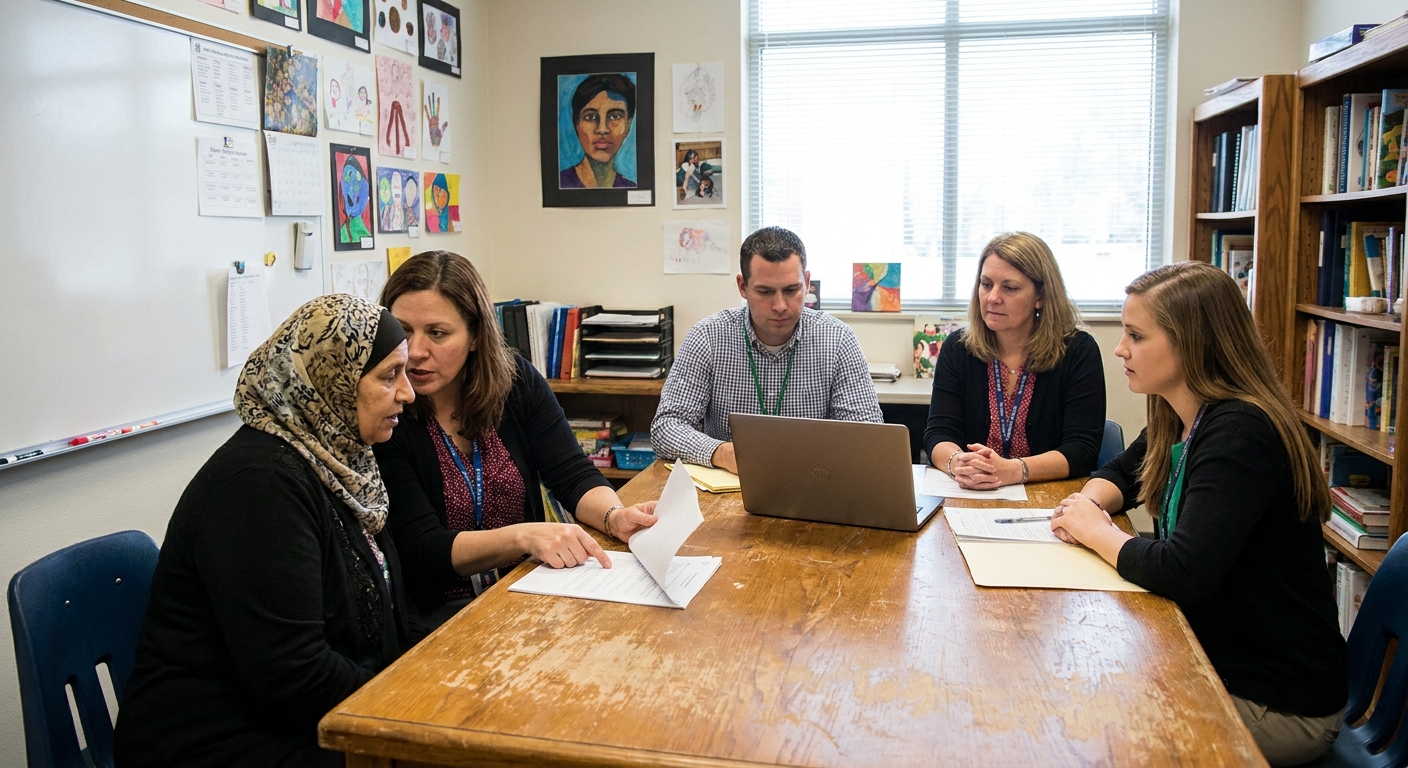
Who attends an IEP meeting?
An IEP is a team plan. The exact list can vary, but meetings often include:
- Parent(s)/guardian(s)
- Student (often encouraged, especially by middle school and above, depending on comfort and needs)
- General education teacher
- Special education teacher
- District representative (someone who can commit school resources)
- Evaluator(s) who can explain assessment results (school psychologist, speech-language pathologist, etc.)
- Others invited by the family or school (advocate, outside therapist, interpreter)
If English is not your strongest language, you can request an interpreter. You deserve to fully understand the plan and participate meaningfully.
What’s inside an IEP?
Most IEPs include the following building blocks. Seeing them listed ahead of time can make the paperwork feel far less intimidating.
- Student strengths and parent concerns
- Present levels of performance
- Annual goals and sometimes short-term objectives
- Special education services (what, where, and how often)
- Related services and supports
- Accommodations for instruction and testing
- Participation with nondisabled peers (LRE explanation)
- Behavior plan if needed (sometimes called a BIP)
- Assistive technology if needed (tools that support learning or communication)
- Progress reporting plan
- Transition plan (required no later than age 16 under IDEA, and earlier in some states)
How to prepare
Before the meeting
- Gather examples: a few work samples, teacher messages, report cards, and notes about homework time or stress.
- Write your top 3 concerns: for example, reading fluency, anxiety, organization, behavior, communication.
- Ask for drafts ahead of time if your district provides them. It is easier to think clearly when you are not seeing the document for the first time in the meeting.
- Bring a support person if that helps you stay grounded and take notes.
Questions to ask
- What data shows my child’s biggest needs right now?
- What will instruction look like on a typical week?
- How will progress be measured, and how often will I see updates?
- Which accommodations will be used daily, not only during testing?
- How will we know if we need to adjust the plan?
For students
If you are a student reading this, an IEP is not a label. It is a support plan. When you feel comfortable, sharing what helps you learn, what feels hard, and what goals you care about can make the plan more useful and more respectful.
IEP rights and protections
Special education is built around procedural safeguards, which are simply rules that protect students and families. While every situation is different, here are a few basics most families benefit from knowing:
- You have the right to participate in meetings and decisions.
- You can request evaluations if you suspect a disability.
- You should receive notice when the school proposes or refuses changes (often called prior written notice, or PWN).
- You can disagree and ask questions, request revisions, or seek outside support.
- Plans should be implemented as written, not “when we have time.”
If you feel stuck, start by requesting a meeting in writing and asking the school to explain the data behind its decisions. Clear documentation and calm persistence go a long way.
If you hit a wall
If you and the school cannot resolve concerns, families may have options such as mediation, a state complaint, or due process. Your school’s procedural safeguards notice (or your state education agency website) usually outlines how these work where you live.
FAQ
How long does it take to get an IEP?
Timelines vary by state, but the process typically includes referral, consent, evaluation, eligibility determination, and then the IEP meeting. If you want the most accurate timeline, ask your school for the special education timeline used in your state or district.
Can a student have good grades and still qualify for an IEP?
Sometimes, yes. Grades are only one data point. A student may be working extremely hard to maintain grades, may struggle with functional skills like organization or communication, or may not be making appropriate progress without specialized support. The key question is whether the disability impacts education and requires specialized instruction.
Does a medical diagnosis automatically mean a student gets an IEP?
No. A diagnosis can be helpful information, but schools determine eligibility under IDEA based on educational impact and need for specialized instruction.
What if I disagree with the school’s evaluation?
You can ask questions about the assessments used, request clarification in writing, and discuss additional data. You can also request an Independent Educational Evaluation (IEE) at public expense if you disagree with the school’s evaluation. If the district denies the request, it generally must file for due process to defend its evaluation.
Can an IEP change during the year?
Yes. If supports are not working, you can request an IEP meeting to review data and adjust goals, services, or accommodations. You do not have to wait for the annual review.
A final word
IEPs can feel overwhelming because they sit at the intersection of learning, emotion, and paperwork. But at its best, an IEP is a bridge: it connects a student’s needs to clear, practical support in the classroom. If you take only one step after reading this, let it be this: write down your concerns and ask the school what data they are using and what next step they recommend. You deserve a process that is understandable, collaborative, and centered on your child.