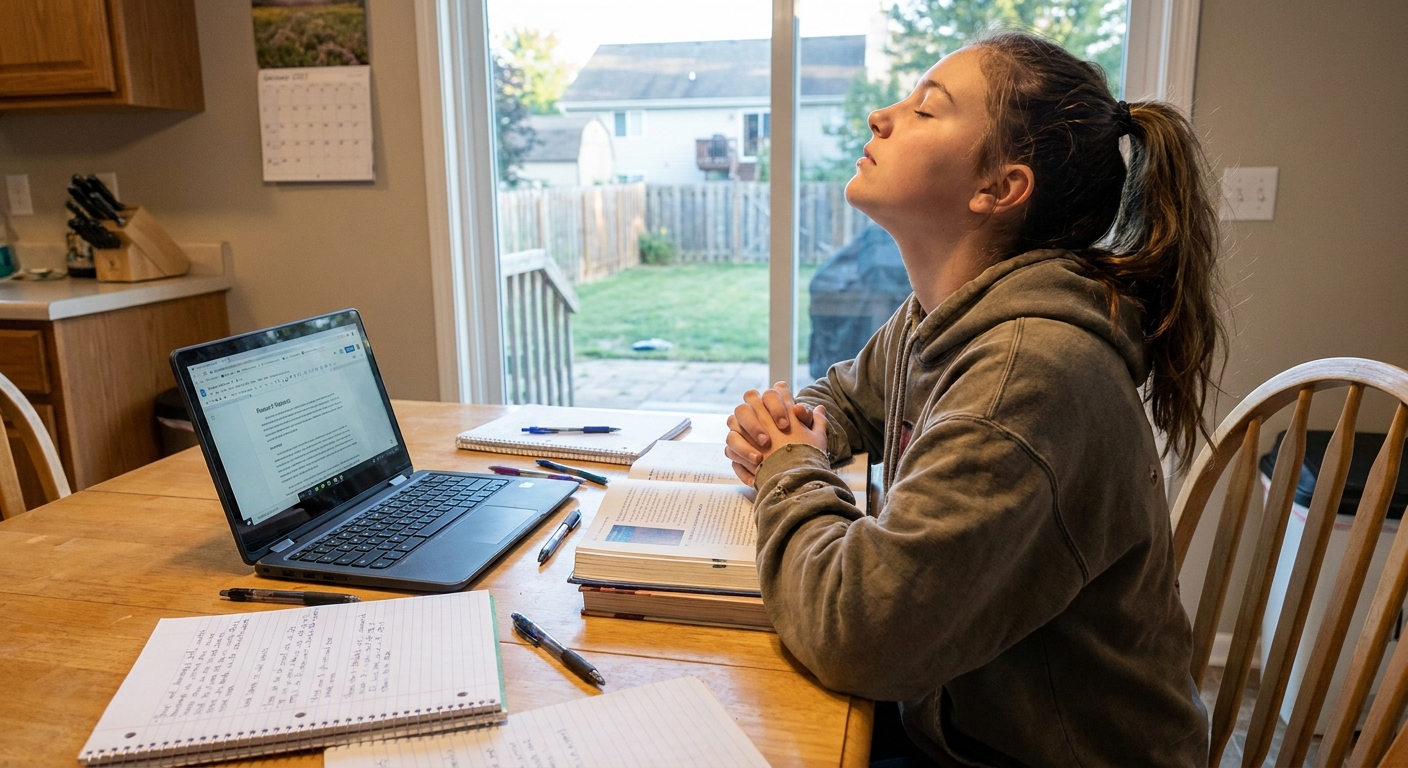
A weekly study plan is not supposed to be a perfect schedule you follow like a robot. It is a flexible map that answers three questions students ask me all the time: What do I need to do, when will I do it, and how will I know I am on track?
Below, I will walk you through a simple weekly system I used as a teacher and advisor. It works for busy middle schoolers, overcommitted high school students, and college students juggling independent deadlines. You will also get a printable-style framework you can copy into a notebook, notes app, or Google Doc.
Quick tool note: If you use paper, this becomes one page a week. If you use Google Calendar, make each study block a calendar event. If you use Notion or a notes app, the framework below can be a reusable template.

Before you plan: three rules
Rule 1: Plan your time, not your motivation
Motivation is unpredictable. Your calendar is usually more predictable than your motivation. A plan works best when it is built around what your week already looks like, not the week you wish you had.
Rule 2: Start smaller than you think
If you are currently studying “whenever,” do not jump to a 25-hour study week. Start with 3 to 6 focused blocks and let consistency build momentum.
Rule 3: Schedule recovery
Brains need breaks. Your plan should include meals, sleep, movement, and true downtime. If it does not, you are not planning. You are overpromising.
Step 1: Set usable weekly goals
Most students plan by listing tasks. That is a start, but it becomes powerful when you pair tasks with a clear weekly goal.
A simple goal formula
- Outcome: What will be finished or improved?
- Evidence: What will you be able to turn in, score, or explain?
- Time: What day and time will it be ready?
Example goals
- Middle school: Finish the science ecosystem poster and practice the 15 vocab words until I can spell them correctly from memory by Friday.
- High school: Draft, revise, and submit the English essay by Thursday night, and score at least 80 percent on Friday’s algebra quiz practice set.
- College: Read and annotate Chapters 4 to 6 by Wednesday, complete the problem set by Friday at 5:00 PM, and outline the lab report by Sunday.
If your goal does not have evidence, it is too vague. “Study for history” is vague. “Complete 30 minutes of active recall using my unit questions and score 18 out of 25 or higher on a self-quiz” is usable.
Step 2: List fixed commitments
Weekly plans fall apart when we pretend the week is empty. Before you schedule study time, list what cannot move.
Fixed commitments checklist
- School or class times
- Commute
- Sports, clubs, rehearsals
- Work shifts
- Family obligations
- Standing appointments
- Sleep target and wake-up time
Once these are on the page, you will see the true study windows. That clarity is the foundation of a plan you can follow.

Step 3: List tasks, then prioritize
Not all tasks deserve the same energy. Prioritizing is how you protect your time and your grades.
The 2-by-2 priority sort
For each assignment, ask:
- Due soon? Is it due in the next 1 to 3 days from when you are planning (Sunday night vs Wednesday changes what counts)?
- High impact? Is it a big grade, hard concept, or a prerequisite for something else?
Then place it into one of these buckets:
- Bucket A: Due soon + high impact (do first)
- Bucket B: Due soon + lower impact (schedule next)
- Bucket C: Not due soon + high impact (start early in small chunks)
- Bucket D: Not due soon + lower impact (fit in last)
When everything feels urgent
This is common, especially mid-semester. When everything feels like Bucket A, use these tie-breakers:
- First: anything with a hard deadline (submission window, quiz time)
- Next: anything that takes the longest (projects, papers, labs)
- Then: anything you have avoided (avoidance is data)
Step 4: Time block your week
Time blocking assigns a job to each open window. The key is to make blocks realistic, specific, and repeatable.
Pick your “home base” blocks
Home base blocks are the study times you can protect most weeks. Many students do best with 3 to 5 home base blocks and 1 flex block.
- Example home base blocks: Monday 4:00 to 5:00, Tuesday 7:00 to 7:45, Thursday 4:00 to 5:30
- Flex block: A backup window (often Sunday afternoon) that catches anything you did not finish
Use a simple block structure
- Focus (25 to 45 minutes): one subject, one task
- Break (5 to 10 minutes): water, stretch, quick walk
- Reset (2 minutes): write what you will do next before you stop
Add two buffers
- Time buffer: As a starting point, leave about 10 to 20 percent of your available time unscheduled.
- Energy buffer: Put your hardest work in your strongest time of day when possible.
If you have ever made a plan you could not follow, chances are you scheduled a “perfect” week with zero buffers.
Step 5: Make blocks startable
Plans fail at the moment of starting. The fix is specificity. When a block just says “chemistry,” your brain has to make extra decisions, which makes starting harder.
Turn subjects into actions
- Vague: Study biology
- Specific: Create 20 flashcards for cell respiration, then self-quiz until I get 17 correct
- Vague: Work on paper
- Specific: Write the intro paragraph plus one body paragraph, then stop and list what evidence I still need
- Vague: Math homework
- Specific: Complete problems 1 to 10, check answers, redo missed ones, and write the step I got wrong
If you are not sure what “specific” means, try this test: Could someone else sit down and do exactly what your plan says without asking you questions?
Printable weekly plan framework
You can copy and paste this into a doc or write it on one sheet of paper each week.
WEEK OF: ____________     SCHOOL / WORK HOURS: __________________

1) THIS WEEK'S TOP GOALS (pick 2 to 4)
- Goal 1: _________________________________________________
  Evidence (what gets turned in or measured): _______________
  Ready by (day/time): _____________________________________
- Goal 2: _________________________________________________
  Evidence: ________________________________________________
  Ready by (day/time): _____________________________________
- Goal 3 (optional): _______________________________________
  Evidence: ________________________________________________
  Ready by (day/time): _____________________________________

2) ASSIGNMENT LIST (dump everything here)
Course/Subject | Task | Due | Est. time | Priority (A/B/C/D)
______________ | _____| ____| _________ | _________________
______________ | _____| ____| _________ | _________________
______________ | _____| ____| _________ | _________________

3) HOME BASE STUDY BLOCKS
- Block 1 (day/time): __________________  Focus task: __________________
- Block 2 (day/time): __________________  Focus task: __________________
- Block 3 (day/time): __________________  Focus task: __________________
- Flex block (day/time): _______________  Catch-up plan: _______________

4) DAILY MUST-DO (the tiny list)
Mon: ____________________
Tue: ____________________
Wed: ____________________
Thu: ____________________
Fri: ____________________
Sat: ____________________
Sun: ____________________

5) WEEKLY CHECK-IN (10 minutes)
Wins: ______________________________________________________
What slipped and why: ______________________________________
One change for next week: __________________________________
Why the “Daily Must-Do” works: It keeps you from opening your planner and seeing a mountain. Each day gets one small anchor task that makes progress almost automatic.
Three examples
Example 1: Middle school
Student reality: After-school activities twice a week, needs help breaking tasks into short bursts.
Top goals
- Finish math worksheet packet (due Friday)
- Study for Friday spelling quiz
- Draft science poster (due next Tuesday)
Home base blocks
- Mon 4:00 to 4:30: Math packet pages 1 to 2
- Tue 4:00 to 4:20: Spelling practice, write and cover method
- Wed 4:00 to 4:30: Math packet pages 3 to 4
- Thu 4:00 to 4:20: Spelling self-quiz, repeat missed words
- Sun 2:00 to 2:30: Science poster outline and gather materials
Why it holds up: The blocks are short and predictable. The plan starts the science project early in a low-pressure way.
Example 2: High school
Student reality: Sports practice most days, multiple classes with different workload patterns.
Top goals
- English essay final draft (due Thursday)
- Algebra quiz Friday
- AP reading annotations (due Monday)
Home base blocks
- Mon 7:00 to 8:00 PM: English, revise thesis and outline
- Tue 7:00 to 7:45 PM: Algebra, practice set and corrections
- Wed 7:00 to 8:00 PM: English, write body paragraphs
- Thu 6:30 to 7:15 PM: English, final edit and submit, then pack quiz materials
- Sun 3:00 to 4:00 PM (flex): AP reading annotations and catch-up
Tip I give my athletes: Put one lighter, “automatic” task right after practice (like a 15-minute review or flashcards). Save heavy writing for a time you can shower, eat, and reset first.
Example 3: College
Student reality: More independent time, but fewer external reminders. Deadlines can cluster.
Top goals
- Psych reading notes for discussion (Wed)
- Calculus problem set (Fri)
- Lab report outline (Sun)
Home base blocks
- Mon 10:00 to 11:30 AM: Calculus problems 1 to 6 plus corrections
- Tue 2:00 to 3:00 PM: Psych reading, annotate and write 5 discussion points
- Thu 10:00 to 11:30 AM: Calculus problems 7 to 12 plus corrections
- Sat 1:00 to 2:00 PM: Lab report outline and create a “to find” list for missing data
- Sun 4:00 to 4:45 PM (flex): Finish loose ends and prep Monday
Why it holds up: The problem set is split into two earlier blocks, which reduces panic and improves accuracy. There is also a Sunday flex block, which is a secret weapon for unpredictable college weeks.

If you have zero uninterrupted time
Some weeks, the issue is not motivation. It is that your schedule is packed with work, family responsibilities, or unpredictable needs. You can still plan, but you will plan differently.
- Use micro-blocks: 10 to 15 minutes counts. Pick a single action like “review 10 flashcards” or “outline one paragraph.”
- Attach study to an existing routine: After dinner, before your shift, right after you drop a sibling off, or during a regular commute (audio notes, review questions).
- Keep one tiny daily anchor: Even 5 minutes of active recall keeps the thread so you do not have to restart from zero.
Step 6: Do a weekly review
If you want a plan you can sustain, you need a short review that turns last week into a smarter next week. Ten minutes is enough.
Your 10-minute weekly review
- 1 minute: What did I finish? (List wins, even small ones.)
- 3 minutes: What did I not finish? Be factual, not harsh.
- 3 minutes: Why did it slip? Time estimate off, too tired, unclear task, distractions, unexpected event?
- 2 minutes: What is the smallest change that would help next week?
- 1 minute: Choose next week’s 2 to 4 top goals.
This is how you personalize your plan to your real life. Over a month, tiny adjustments make a huge difference.
Common problems and fixes
“I make a plan, then I ignore it.”
- Fix: If you tend to overplan, cut your planned study time by about 25 percent as a starting point and add a flex block.
- Fix: Make each block startable: “Open doc and write topic sentences” beats “Work on essay.”
“I underestimate how long homework takes.”
- Fix: Track time for one week. Most students are shocked in a helpful way.
- Fix: Use a generous first estimate. One simple heuristic is the “rule of two”: if you think it is 30 minutes, schedule 60 the first time you do that task type, then adjust next week.
“I get distracted during study blocks.”
- Fix: Put your phone in another room for one block per day to practice focus.
- Fix: Use a distraction list: write down the thought and return to the task.
“I have too many subjects to fit everything.”
- Fix: Rotate maintenance blocks. Not every subject needs equal time every week.
- Fix: Prioritize high-impact learning methods (practice problems, active recall, writing) over rereading.
Helpful tweaks for attention and anxiety
If focusing is hard for you, you are not alone. You do not need a whole new personality. You need a friendlier setup.
- Shorten the block: Try 15 to 25 minutes, then take a real break.
- Use a visual timer: Seeing time pass makes it easier to stay with the task.
- Try body doubling: Study near someone else (in person or on a quiet video call) to make starting and staying on task easier.
- Lower the starting bar: Your first step can be “open the assignment and label the parts.” Momentum usually follows.
For parents and caregivers
If you are supporting a student at home, you do not need to become the homework police. Your role is to help them build the habit and the environment.
- Ask: “What are your top two goals this week?” (not “Do you have homework?”)
- Help them pick a consistent planning time (Sunday evening often works well)
- Encourage short study blocks for younger students
- Celebrate follow-through, not perfection
- If they fall behind, help them choose what to do first instead of shaming the backlog
FAQ
How many hours should I study each week?
It depends on course difficulty, pace, and how efficiently you study. A practical starting point is to schedule 3 to 5 focused blocks per week and adjust after your weekly review. College students often need more total time, but splitting it into multiple blocks is usually more effective than marathon sessions.
Should I plan every minute of my day?
No. Over-scheduling is a common reason plans fall apart. Time block the essentials, include buffers, and leave open space for real life.
What if I miss a study block?
Treat your plan like a GPS. You do not “fail,” you reroute. Move the task to your flex block or swap with a lower-priority task. Then note why it happened during your weekly review.
Is it better to study a little every day or do longer sessions?
Most students benefit from a mix: short daily review for memory and one or two longer blocks for writing, projects, or complex problem sets. The weekly plan is where you balance both.
Your next step
If you take one action today, make it this: set a 20-minute timer and fill out the framework for next week. Pick just two top goals, choose three home base study blocks, and add one flex block. That is enough to start building a plan you can actually follow.