
Falling behind on homework can feel like carrying a backpack that gets heavier every day. The goal of this plan is not perfection. It is regaining control in a way that protects your sleep, your confidence, and your relationships with teachers.
This 7-day recovery plan assumes you are behind in more than one class. It will help you decide what to do first, break work into small sessions, and communicate clearly without feeling like you are “in trouble.”
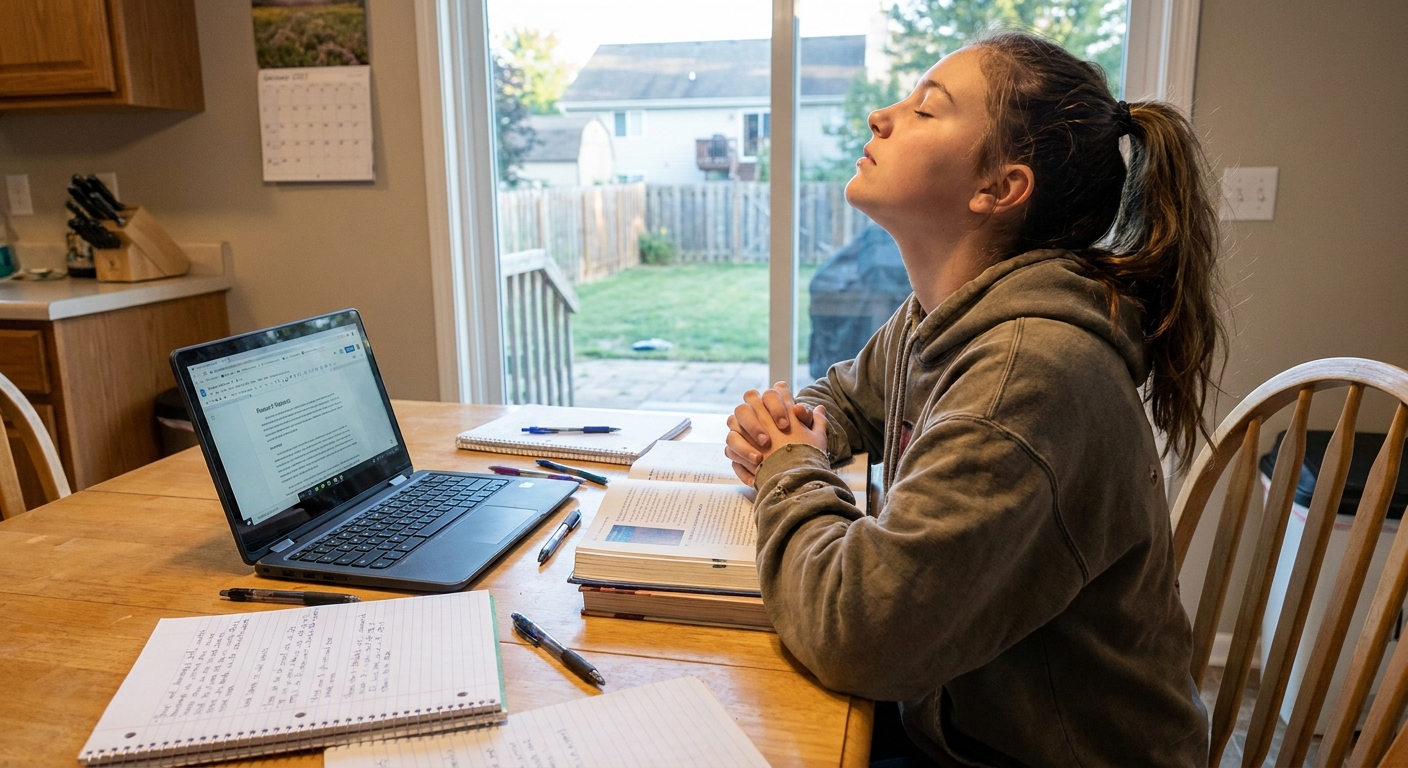
What you need before you start: a list of classes, a way to track tasks (paper or phone), and a timer.
Before Day 1: Set your rules
When you are behind, the biggest danger is trying to fix everything at once. These simple rules keep you from burning out.
- Work in short blocks. Aim for 25 minutes of work, a 5-minute break. After four rounds, take a longer break.
- Do not pull an all-nighter. When you are tired, schoolwork usually takes longer and errors are easier to make. If you are already exhausted, you are not “lazy.” You are overloaded.
- Start with points and deadlines, not guilt. Base your plan on what affects your grade and what is time-sensitive.
- Finish small things on purpose. Quick wins rebuild momentum.
If you have a job, sports, family responsibilities, or you are managing anxiety or ADHD, keep the blocks even shorter. Ten focused minutes still counts.
Quick policy check: before you choose what to tackle, skim each class syllabus or LMS page for late-work rules. If you cannot find it, include that question in your teacher message.
Step 1: Make an inventory (30 minutes)
You cannot prioritize what you have not named. Set a timer for 30 minutes and make one master list.
How to build your list fast
- Open your learning platform (Google Classroom, Canvas, Schoology, etc.) and write down everything missing.
- Check your gradebook for zeros or “missing.”
- For each item, capture four details: class, assignment name, due date (or original due date if it is late), and estimated time.
Estimating time does not need to be perfect. Use simple categories:
- Quick: 10 to 20 minutes
- Medium: 30 to 60 minutes
- Heavy: 90 minutes or more
When in doubt, underestimate slightly and plan to revisit. You can always adjust tomorrow.

Step 2: Use 3 buckets
This method keeps you from getting stuck on the wrong work first.
Bucket A: Must do first
- Anything due in the next 48 hours
- Anything worth a large portion of your grade (tests, labs, essays, projects)
- Anything your teacher has said is required to move forward (for example, you cannot do the next lab without the previous one)
Bucket B: High value, flexible
- Assignments that matter but are not immediate
- Make-up work with a late window
Bucket C: Low value for now
- Small homework grades that may not move your overall average much
- Old assignments that may not be accepted, or would take hours for little credit
Bucket C is not “never.” It is “not right now.” When you are behind, choosing not to do something first can be a smart decision.
Step 3: Turn your list into a schedule
Lists lower anxiety, but calendars create follow-through. Take 10 minutes to place your Bucket A tasks into real time slots.
- Pick a start time that is realistic (after dinner, after practice, during study hall).
- Schedule in blocks, not vague promises.
Example: “7:00 to 7:25: math practice set (Quick). 7:25 to 7:30: break. 7:30 to 7:55: English outline (part 1).”
If you do not finish a block, that is okay. You just move the next block. You are building a system, not proving worth.
Talk to teachers
This is the part many students avoid, and it is often the fastest way to reduce pressure. Many teachers respond well to a clear plan and a respectful tone, even if you are missing a lot.
What to say in an email
Keep it short. Include: what happened (briefly), what you are doing now, and what you are asking for.
Email template: what to prioritize
Subject: Plan to catch up in [Class Name]
Hi [Mr./Ms./Mx. Last Name],
I am behind on a few assignments in [Class Name], and I am making a catch-up plan this week. Could you tell me which missing assignments you would like me to prioritize first, and what your late-work options are?
Thank you for your time. I appreciate it.
[Your Name], [Period/Section]
Email template: propose a deadline
Subject: Request for a short extension in [Class Name]
Hi [Mr./Ms./Mx. Last Name],
I am working to catch up on missing work. I can complete [Assignment Name] by [Day, Date]. Would it be possible to submit it then for partial credit?
Thank you,
[Your Name], [Period/Section]
If emailing feels overwhelming, ask a counselor, advisor, case manager, or trusted adult to help you send the first one. After that, it usually gets easier.
If you have a 504/IEP: loop in your case manager or support teacher early. Ask for a catch-up plan that matches your accommodations (reduced load, extended time, chunking, alternate format, or check-ins).
Your 7-day plan
Think of this week as a reset. You are building a system you can reuse anytime life gets busy.
Day 1: Inventory and quick wins
- Make your master list and sort into Buckets A, B, and C.
- Send 1 to 3 teacher messages (the classes with the biggest impact first).
- Complete two Quick assignments tonight. Stop after two to protect consistency and sleep.
Why this works: finishing small tasks lowers stress and helps you build momentum.
Day 2: Highest-impact first
- Choose one Heavy or high-point assignment from Bucket A.
- Break it into steps (for example: outline, first paragraph, two body paragraphs, conclusion, edit).
- Do 2 to 4 short work blocks depending on your schedule.
If you get stuck, write down a single question to ask your teacher or a classmate. Do not stare at it for 45 minutes.
Day 3: Unblock your learning
- Identify any assignment that is preventing you from understanding current lessons.
- Do that assignment or the key portion of it.
- Spend 15 minutes reviewing today’s class material so you do not keep falling further behind.

Day 4: Checkpoint
- Check teacher replies and update your plan based on what they said.
- Move anything not accepted or low-value into Bucket C for now.
- Finish 1 Medium assignment and 1 Quick assignment.
Mindset: adjusting your plan is not quitting. It is good project management.
Day 5: Build momentum
- Complete the next Bucket A item due soonest.
- Start a Bucket B item that will take more than one session (project, essay, lab).
- End by setting up tomorrow: open the doc, label the sections, gather sources, or write the first two sentences.
This “tomorrow setup” step is one of my favorite tricks from years of teaching. Starting is often the hardest part, so you make tomorrow easier.
Day 6: Deep work day
- Do 3 to 6 work blocks total, with breaks.
- Aim to finish one Heavy task or two Medium tasks.
- Use a focus helper: study playlist, website blocker, or a quiet public place like a library.
If you have family plans or work, shrink the blocks. A “deep work day” can be 90 minutes total if that is what you have.
Day 7: Clean-up and maintain
- Submit anything finished, even if it is not perfect.
- Follow up with any teacher you have not heard back from.
- Create a maintenance plan for next week: 20 to 30 minutes daily of “current homework first,” plus 2 to 3 catch-up blocks.
End Day 7 by choosing your Top 3 priorities for next week. When you wake up Monday already knowing what matters, school feels lighter.
Make work feel smaller
When you are behind, your brain often treats every assignment like one huge, scary thing. Instead, write the next tiny step only.
- Instead of: “Write history essay”
- Write: “Open doc and paste prompt”
- Then: “Find 2 quotes from notes”
- Then: “Write thesis draft (1 sentence)”
Momentum comes from finishing steps, not from thinking about the final product.
If one week is not enough
Sometimes the honest answer is that you cannot do it all in 7 days, especially after illness, a family situation, or mental health challenges. You still have options.
Ask for a reset plan
Many teachers will work with you on a reduced set of assignments that proves you learned the skills. That might look like:
- Completing only the most important missing labs or essays
- Redoing a quiz instead of turning in five old worksheets
- Submitting one “master assignment” that covers multiple standards
Talk to your counselor if:
- You are failing multiple classes and do not see a path forward
- You have missed a lot of school days
- You feel panic, dread, or shutdown when you try to start
Support is not a reward for students who are already doing well. It is for students who need a hand getting back on their feet.
Common roadblocks
I sit down and freeze
- Set a 5-minute timer and do the tiniest step possible.
- Tell yourself you can stop after 5 minutes. A lot of students find it easier to keep going once they start.
I keep doing easy tasks only
- Pair them: one Quick task, then 25 minutes on the big task.
- Start the big task with a “messy draft” mindset. You can clean it later.
I am worried my teacher will be annoyed
- Polite, proactive communication often improves relationships.
- A plan is reassuring. Avoid long explanations and focus on next steps.
I cannot focus at home
- Try a different environment: library, school study hall, or a quiet corner at a relative’s home.
- Use noise-canceling headphones or simple background sound.
I am tempted to copy because I am panicking
- Pause and ask for help. Teachers almost always prefer late honest work over dishonest work.
- If you are stuck, submit what you can and add a note: “I got to this point and then got confused about ___.”
FAQ
Missing work or today’s work first?
In most cases, do today’s homework first so you do not keep adding to the pile, then use a set amount of time for catch-up. If a missing assignment is blocking you from understanding current lessons, do that one first.
How long should I work each day?
Start with what you can sustain. For some students, 60 to 120 minutes total (in short blocks) is a solid starting range, but it depends on your workload, grade level, and course difficulty. If you need more time, add it gradually on Day 6 when you can rest afterward.
What if late work is not accepted?
Still communicate. Ask if there is an alternative like a retake, a replacement assignment, or tutoring to demonstrate mastery. Even when points are not available, catching up on the skill helps you do better on tests and future assignments.
What if I am behind because I did not understand?
That is a learning problem, not a character problem. Your plan should include help time: office hours, tutoring, a study group, or a 10-minute video lesson on the exact skill you missed. Then return to the assignment with a clearer brain.
A note from a former teacher
If you are behind, you are not alone, and you are not a lost cause. I have watched students turn a tough semester around by doing three things consistently: prioritize what matters, work in small sessions, and communicate early. This plan gives you a structure. Your job is to take the next small step today.