
Homeschool planning can feel like you are building an entire school from scratch. The good news is you do not need a perfect plan. You need a workable plan that matches your child, your family’s energy, and the realities of life.
In my years teaching and advising families, the homeschool years that tend to “stick” often share three things: clear priorities, a simple weekly rhythm, and a built-in way to adjust when something is not working. Let’s build that.
Start with what matters
Before you pick curricula or make a schedule, define the purpose of your homeschool year in plain language.
Step 1: Write your north star
Answer these prompts in one or two sentences each:
- What do we want more of this year? (confidence with reading, calmer mornings, curiosity, outdoor time)
- What do we want less of? (tears at math, rushed afternoons, constant catch-up)
- What are our non-negotiables? (daily reading, math practice, family dinner, therapy appointments)
This matters because it gives you a decision filter. When you feel tempted to add “one more program,” you can ask, “Does this support our north star?”
Step 2: Choose 3 to 5 outcomes
Keep outcomes realistic and observable. Examples:
- Read aloud together 4 days a week.
- Finish one full math program level (or complete 28 out of your planned units).
- Write one paragraph with a clear topic sentence by December, then a multi-paragraph piece by May.
- Complete 6 science labs and keep a simple lab notebook.
- Participate in one consistent community activity (co-op, sport, music, scouts).
Pick subjects wisely
Many families find planning in two layers works well: core (steady skills) and enrichment (interest-led electives that keep learning joyful).
Core: keep these steady
- Reading and language arts: reading, writing, spelling or word study, grammar as needed.
- Math: consistent practice is often more helpful than long lessons.
- Science: in early grades this can be gentle but still regular (nature study, picture books, simple experiments), then deeper in middle and high school.
- Social studies: history, geography, civics, culture.
Electives: choose 1 to 3 per term
Electives are where you personalize. They also help prevent burnout when they are chosen wisely. Options include:
- Art, music, coding, robotics
- Foreign language
- Life skills (cooking, budgeting, typing)
- Health and physical education
- Interest studies (dinosaurs, space, mythology, architecture)
A simple filter
If you are feeling overwhelmed, try this:
- Daily: math, reading, writing (short counts)
- Weekly: science, social studies, electives on set days
- Loop: extras that rotate (poetry, logic puzzles, art appreciation)
Choose curriculum that fits
Curriculum shopping can spiral fast. Instead of asking “What is the best homeschool curriculum?”, ask “What is the best fit for this child and this season?” Approaches vary, and that is normal.
Four fit questions
- Teaching load: Is it parent-led, student-led, or mixed? How many minutes of direct teaching per day?
- Learning style: Does your child need movement, visuals, audiobooks, hands-on practice, or short bursts?
- Open-and-go vs. customizable: Do you want a script and checkboxes, or flexibility?
- Assessment comfort: Are you okay with quizzes and tests, or do you prefer projects and narration?
My “good enough” curriculum stack
If you want something simple that works for many families, start here and customize later:
- Math: one complete program
- Reading: daily independent reading plus read-alouds, and phonics if needed
- Writing: one gentle routine (journaling, copywork, paragraph practice) and build up over time
- Science or social studies: one family-style program if you have multiple kids
If you have more than one child, combining science and social studies can be the secret to a peaceful homeschool. Different kids can do different assignments, but you share the main content together.
Set a weekly rhythm
A weekly rhythm is different from a strict schedule. It answers, “What happens on which day?” so you are not reinventing the wheel every morning.
Option A: Classic days
- Monday: new lessons, plan the week, library books
- Tuesday: science focus, lab or nature study
- Wednesday: social studies focus, writing workshop
- Thursday: electives, co-op, field trip day
- Friday: review, catch-up, projects, portfolio work
Option B: A/B days
Great if you want fewer daily subjects.
- A days: math, language arts, science
- B days: math, language arts, social studies, electives
Option C: Loop schedule
Pick 4 to 6 loop subjects. Do the next one on the list each day after core work. When life happens, the loop pauses and then resumes.
- Example loop: science, history, art, coding, health, geography
Balance workload
A common planning trap is trying to do every subject at full intensity all year. Instead, balance by weight (minutes and effort) and by season (what you emphasize when).
Use the 60/40 guideline
For many elementary and middle school homes, a helpful starting point is:
- 60% core (math, reading, writing)
- 40% everything else (science, social studies, electives, projects)
Plan electives in short terms
Instead of trying to keep three electives going for your entire school year, try 6 to 12 week terms.
- Fall term: art and nature journaling
- Winter term: coding and typing
- Spring term: music and a hands-on science project
Protect a light day
Build in at least one lighter day each week. Light days help prevent the spiral of constant catch-up.
- Core only
- Read-aloud and math games
- Field trip or co-op
- Independent project time
Simple schedules
These are intentionally simple. Adjust the start time and the blocks to fit your family.
Schedule 1: Elementary (K to 5)
- 9:00 to 9:15 Morning basket (read-aloud, calendar, poem, prayer or mindfulness)
- 9:15 to 9:45 Math
- 9:45 to 10:05 Snack and movement
- 10:05 to 10:35 Reading or phonics
- 10:35 to 10:55 Writing (copywork, narration, handwriting)
- 10:55 to 11:25 Science or social studies (alternate by day)
- 11:25 to 11:45 Elective (art, music, typing)
Schedule 2: Middle school (6 to 8)
- 9:00 to 9:15 Plan the day, quick review
- 9:15 to 10:00 Math
- 10:00 to 10:45 Language arts (reading, writing, grammar)
- 10:45 to 11:05 Break
- 11:05 to 11:55 Science (lab two days a week)
- 11:55 to 12:35 Social studies
- After lunch Elective or co-op, plus independent reading
Schedule 3: High school (9 to 12)
Many high schoolers do well with a mix of independent work and planned check-ins. Your teen may need more or less structure depending on maturity, learning needs, and outside commitments.
- Monday: plan the week, set goals, start new lessons
- Tuesday to Thursday: 3 academic blocks (45 to 70 minutes each) plus one lighter block
- Friday: quizzes, labs, writing submissions, catch-up, transcript logging
Example day (Tue to Thu):
- Block 1: Math
- Block 2: English
- Block 3: Science or history
- Block 4: Elective, PE, or part-time job hours

Plan by grade level
The same planning framework works at every stage, but what you count as “school” often shifts as kids grow.
Early elementary (K to 2)
- Focus: phonics, read-alouds, number sense, fine motor skills, play
- Time tip: short lessons, lots of breaks. Twenty focused minutes can beat an hour of struggle.
- Curriculum tip: keep it hands-on. Use manipulatives, songs, and simple routines.
Upper elementary (3 to 5)
- Focus: reading fluency, writing stamina, math facts plus conceptual understanding
- Time tip: begin simple independence like checklists and timers.
- Curriculum tip: introduce note-taking gently using picture notes or short outlines.
Middle school (6 to 8)
- Focus: study skills, organization, deeper writing, labs and research
- Time tip: shift from many small subjects to fewer longer blocks.
- Curriculum tip: choose at least one area for real challenge and one for confidence building.
High school (9 to 12)
- Focus: credits, mastery, documentation, and next-step planning
- Time tip: use weekly planning meetings and due dates, not daily micromanagement.
- Curriculum tip: confirm expectations if your teen may attend college, trade school, or military programs. Keep course descriptions and samples of work.
High school documentation basics
Requirements vary widely by location and by post-graduation goals, so check local rules and any target college or program expectations. In most cases, these basics make life easier:
- Transcript plan: decide what counts as a credit (time based, mastery based, or a mix).
- Course descriptions: keep a short summary of materials used, topics covered, and major assignments.
- Work samples: save a few strong pieces per subject (labs, essays, projects), especially for portfolio reviews.
- Grades: choose a grading approach that you can explain consistently (points, rubrics, or mastery checklists).
- Testing and options: note potential standardized tests, dual enrollment, internships, or career exploration as part of the plan.
Measure and adjust
Plans fail when they are rigid. Strong homeschool years have built-in checkpoints where you adjust the workload, swap resources, or slow down.
Use a 4-week check-in
Put a recurring reminder on your calendar every four weeks. Ask:
- What is working and why?
- What is consistently not getting done?
- Is anything causing daily conflict?
- Do we need shorter lessons, fewer subjects, or a different approach?
Simple ways to track progress
You do not need elaborate testing to get real data. A few low-effort habits can tell you a lot:
- Reading: a simple reading log, plus one recorded read-aloud passage every month or two.
- Math: unit checks, error patterns you notice, or one timed facts check if that fits your child.
- Writing: save one dated writing sample each month.
- Portfolio: take quick photos of projects, models, and lab pages as you go.
Hard week vs. broken plan
- Hard week: keep the plan, reduce the volume, add rest.
- Broken plan: the same subject causes stress for two or more weeks, or you are always behind. That is your signal to change something.
Three quick fixes
- Reduce daily subjects. Keep math and reading daily, rotate the rest.
- Shorten lessons. Try a 20 to 30 minute cap for elementary, and 45 to 60 for older students.
- Switch the format. If writing is a battle, try dictation, speech-to-text, or scribing temporarily while you build skills.
A real-life example: One student I worked with could explain ideas beautifully but froze when it was time to write. We used speech-to-text for four weeks while practicing one small writing skill at a time (topic sentences, then simple transitions). When the pressure dropped, the writing skills started to stick.
Special situations
Some seasons need a different kind of plan. You are not doing it wrong. You are adapting.
If you are stretched thin
- Working parent: prioritize independent-friendly core work, and use read-aloud audiobooks plus discussion at dinner.
- New baby or caregiving season: do a two-subject minimum (math plus reading), and treat everything else as a loop.
- Neurodivergent learners: shorten lessons, add movement breaks, and choose curriculum with clear steps and fewer distractions.
- Chronic illness weeks: switch to “micro school” days: read-aloud, math review, and one gentle content activity.
Where to get support
If you are unsure what to buy or how to structure a course, these options can help you decide with less guesswork:
- Your library: curricula samples, read-aloud stacks, audiobooks, and free classes.
- Local communities: co-ops, museum programs, park days, and homeschool associations.
- Used curriculum groups: an affordable way to test what fits before you commit.
- Online classes: a good option for labs, writing feedback, advanced math, or when you need outside accountability.
Planning checklist
Use this as your simple get-started list. You do not need to finish it all in one weekend.
- Confirm requirements: check your state, province, or country rules. Requirements vary widely and can include attendance days, subjects, evaluations, portfolios, or notices of intent.
- Pick your year structure: a typical 36-week year, 4 terms, year-round, or a flexible week count.
- Write your north star: priorities plus 3 to 5 outcomes.
- Choose core subjects: math, language arts, plus a plan for science and social studies.
- Select electives: 1 to 3 for the first term only.
- Decide your weekly rhythm: classic days, A/B days, or loop schedule.
- Create a daily flow: start time, 2 to 4 learning blocks, and breaks.
- Gather materials: books, manipulatives, notebook system, basic art and science supplies.
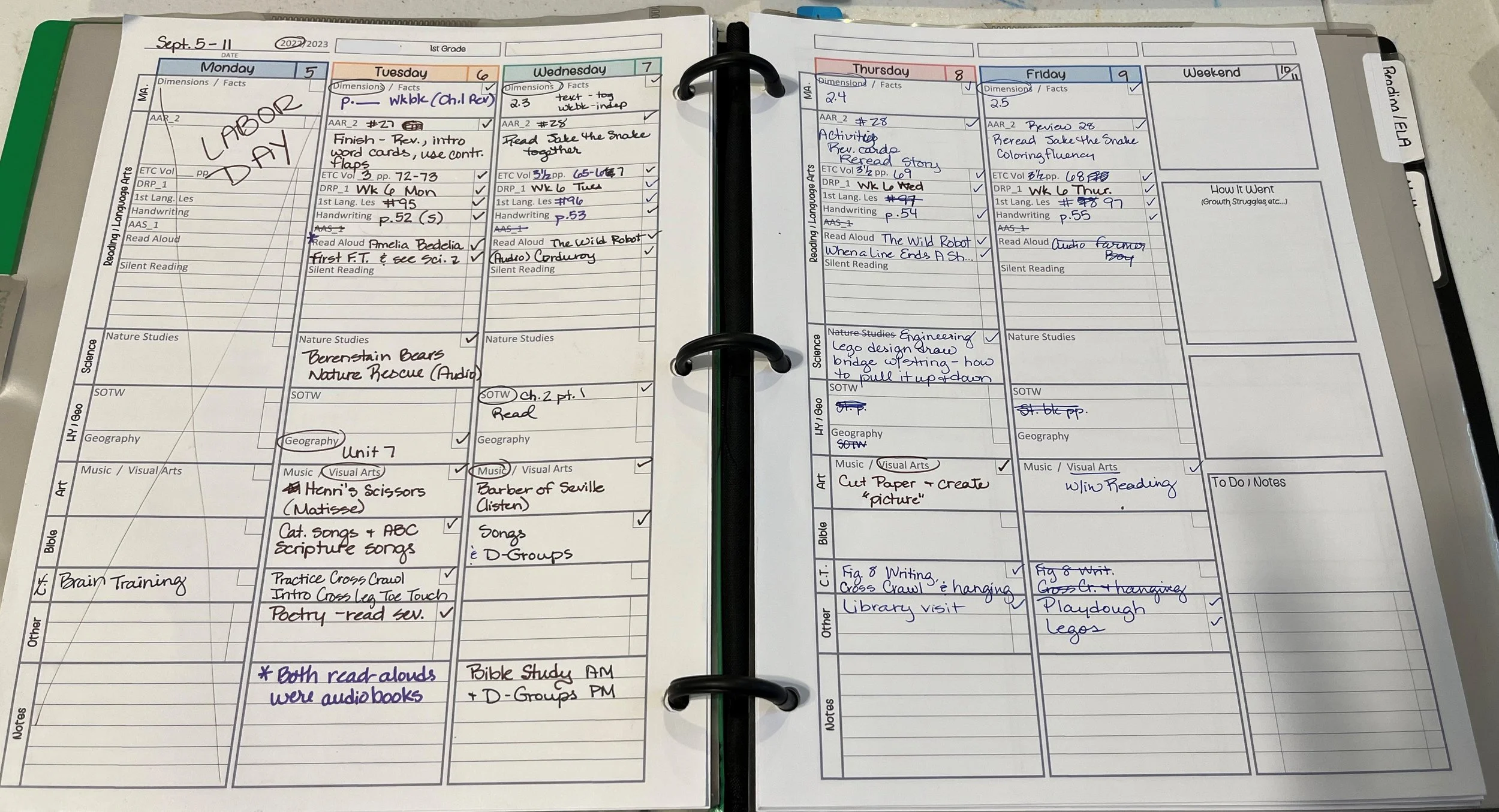
- Set up tracking: a planner, checklist, spreadsheet, or portfolio binder.
- Plan your first two weeks: resist planning every week in detail upfront.
- Add a 4-week check-in date: schedule it now.
My teacher tip: plan the first month like you are onboarding a new job. You are learning the system. You will refine it once you have real data from your child.
Common questions
How many hours a day should we homeschool?
It depends on age, learning needs, and local requirements. Check your jurisdiction’s rules for any minimum days or hours. That said, many families land in these ranges for focused instruction time (not counting free reading, play, outings, or life skills):
- K to 2: 1 to 2.5 hours
- 3 to 5: 2 to 4 hours
- 6 to 8: 3 to 5 hours
- 9 to 12: 4 to 6 hours including independent work
Homeschooling can be efficient. Transitions, assemblies, and classroom management time are not part of your day.
Do I need every subject every day?
No. Many families find daily math and reading works well, plus rotating content subjects and electives across the week.
What if I choose the wrong curriculum?
Give it a fair trial, usually 3 to 6 weeks, then adjust. If your child is melting down daily or you dread the lesson every morning, it is okay to pivot. Switching is not failure. It is responsive teaching.
How do I homeschool multiple ages?
Combine what you can (read-alouds, science, history, art), separate what you must (math, phonics), and use a weekly rhythm so everyone knows what to expect.